Showing posts with label Philippines. Show all posts

Saturday, October 23, 2010

Summer report

“Review your goals twice every day in order to be focused on achieving them.”
~Les Brown

I had a lovely summer, it buzzed with activities and I enjoyed every minute of it. In three months' time, I worked in different health care facilities, took care of our garden, traveled outside Finland twice, and of course I took pictures of nature and some man-made structures. Looking back, I couldn't believe how I managed to juggle all of those. It was a fun and productive season, and boy it sucks how fast time flies.. sigh. Anyhow, in my previous blog entry I was brave enough to mention that I was getting bored with my photography style. I bet some of the people who has been viewing my work since I started showing them off on web galleries do feel the same. Because of that, I thought I should try my very best to make my macro photos look like art pieces, not just mere insect and flower photos that would look good on textbooks where kids could label every part. So... was it a success or a flop? You're about to find out..

A for effort
I tried my best, but I'm giving myself an F because I am simply not satisfied with how the flower macros came out. Yeah, my standards are way too high for an amateur, nothing can change that. However, I should get an A for effort and for always believing that my camera can do wonders. Actually, I deserve more than an A, I think I should get a medal for my false beliefs. I took at least a hundred photos of flowers, I set the aperture to f2.8, and voila! Only 10% turned up to be decent enough. Backed with my years of practice shooting on macro mode, I know quite well which part of the subject to focus on. The difficult part is adding drama to the image, allowing it to tell a story and making it look visually appealing at the same time. Since I do not excel in the creativity department, I ended up deleting so many shots because they looked so dull. Oh, I've still got a lot to learn. Below is one of the few photos that passed my standards, the aperture was f/3.5 though.

passion for detail
Passion for detail

I took that flower photo in a park when I was in a photowalk with my best friend. I was telling her about depth-of-field and its impact on the photograph.
For the record, I owe her big because she was the one who told me that I have to press that tulip button on my camera if I want to take close-up photos. If not for that tip, I probably wouldn't discover the wonderful world of macro photography. It's just but fitting that I share with her some photography tips, just the basic stuff because that's all I know :-)


A for confidence
Some hobbyists have inferiority complex secondary to the use of less expensive gadgets. Oh am I ever so glad I didn't develop that condition.
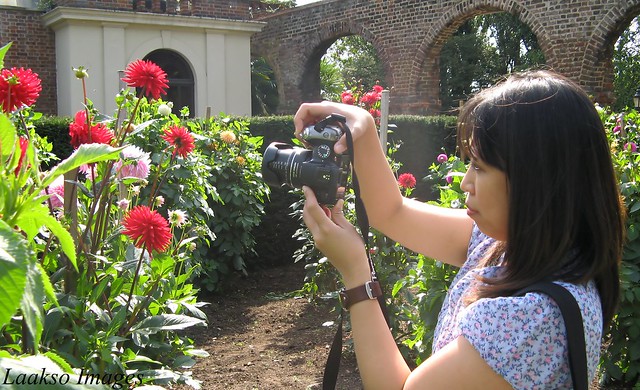
In fact my 'student's camera is way better than mine, but that didn't bother me at all. I gave her macro tutorials in the lovely parks of London. I enjoyed it so much because it made me realize that I actually know some photography stuff. I owe it to the people who take time to comment on my photos. My lack on insecurity as far as cameras and gears are concerned, also plays a significant part. I don't mind rubbing elbows with DSLR users, in fact the best part of my vacation in the Philippines has always been the photowalks of Pinoy Macro, my favorite Flickr group. I bet not all point and shoot users would feel comfortable being surrounded with guys using heavy cameras and powerful lenses, but I've got confidence in me :-) Most of my favorite shots were taken when I was with those macro masters. Perhaps it's due to the positive energy that I get when I hang out with them. Check out the photos below, you non-believers.

Bonding session
Bonding session

My creation
1. in the spotlight, 2. I'm a lady!, 3. Steady, 4. exotic little thing

A for going beyond macro
Whenever I travel, I see to it that butterfly sanctuaries are part of the itinerary. Sometimes I take the beautiful man-made structures for granted. Last summer, however, was different. I finally gave in to the long overdue request of my sister who wanted to see the more photos of the places I visit. So I revisited the buildings of the Finnish capital, took photos of the London street scenes, castles, and other lovely sights. It went well, me thinks. After all, buildings and bridges do not move. It was just a matter of choosing the best angle to shoot from.
Parliament House
Parliament House, Helsinki

My creation
1. Buckingham Palace, 2. London bridge, 3. Hampton Court Palace, 4. View from London Eye


Straight A's? That's too good to be true, so to balance things kindly allow me to bash myself as well. I already mentioned one F because I failed to deliver impressive flower macro shots, but it doesn't stop there.

F for post-processing skills
The functions of most stuff in the photoshop tool box remain a mystery to me. I can't even upgrade to newer versions because of my fear that it would again be a struggle to learn the basics. I barely exert effort on learning photoshop because it's time consuming. I would rather take new pictures than sit down and try to make an old one look better.

F for technical knowledge
I've been shooting for 4 years and I’m still confused about ISO. My attention span is exceptionally short for articles that mention numbers. I asked my husband about that many times, but I can't remember much about what he said because I always get lost in his beautiful blue eyes. I just end up saying: to hell with ISO settings, the world will not end if I don't know how to adjust it :-) Moral of the story: don't get tutorials from handsome guys, you won't learn much. Don't say I didn't warn you.

So there you have it. Now you know how this shutterbug spent summer. I tried, I failed, and I've still got more room for improvement. Oh, and I have always been a lady, haha! I had to point that out because one forum member once called me 'sir'.

Saturday, October 31, 2009

Butterfly-inspired

May the wings of the butterfly kiss the sun
And find your shoulder to light on,
To bring you luck, happiness and riches
Today, tomorrow and beyond.
~Irish blessing

A thing of beauty
Photo title: A thing of beauty
Camera: Canon PowerShot A710 IS
Exposure: 0.005 sec (1/200)
Aperture: f/4.0
Focal Length: 5.8 mm
Exposure Bias: 0 EV
Flash: Off, Did not fire
Location: Kerimäki, Finland
Date & time: 25.8.09 17:09:28

I was browsing my favorite science news site for some serious stuff, when something colorful caught my eye. I usually visit that site to look for medical and health updates, but today, a close-up shot of a butterfly's wings made me forget what I came there for. Because of that photo, I found out that I'm not the only one who is fascinated with the patterns and colors of butterflies' wings.

Last year, Marco Giraldo of University of Groningen, Netherlands, discovered that the appearance of the butterfly wings is influenced by both color pigments and the tiny scales that make up the wing. Butterflies' wings are made up of two layers of overlapping scales that efficiently reflect light. This discovery inspired scientists to replicate biological structures of butterfly wings to make optically active structures such as optical diffusers for solar cells. Simply put, solar panel technology may improve because the charisma of butterflies tickled the curiosity of scientists. Sweet! That's an undeniable proof that little creatures must never be ignored. They are more than critters, they are pretty creatures that help improve human lives in their own tiny, yet powerful ways.

It's quite a pity that some people are scared or even disgusted of butterflies. Moths and butterflies don't bite, I wonder why people are scared of them. There was a time I saw a middle-aged man trying to kick something out of its way. I thought it was a cockroach, but to my surprise, it was a huge moth. I picked the moth from floor to save it from heartless humans:
Isn't she lovely?

Who would be scared of something so fragile? That just doesn't make any sense. I travel halfway across the globe just to visit butterfly gardens, and there I hear teenage girls scream when butterflies land on their shoulders. If it was a cockroach sanctuary, I would have understood their disgust. Oh well, there are just too many things in this world that make blood pressure rise. The world needs more scientists who can help humans appreciate nature more... or perhaps more of my butterfly photos :-)

My creation

References:
FECYT - Spanish Foundation for Science and Technology (2009, October 9). Nanometric Butterfly Wings Created.
American Chemical Society (2009, February 5). Natural Solar Collectors On Butterfly Wings Inspire More Powerful Solar Cells. ScienceDaily.
University of Groningen (2008, January 22). Pigmentation In Some Butterfly Wings Created By Nanostructures. ScienceDaily. Retrieved

Thursday, April 2, 2009

Numbers and rules

“Excellence is in the details. Give attention to the details and excellence will come.”
~ Perry Paxton
pardon my nearsightedness
Pardon my nearsightedness
Camera: Canon PowerShot A710 IS
Exposure: 0.005 sec (1/200)
Aperture: f/4.0
Focal Length: 5.8 mm
Modifications: Adjusted temperature & brightness level
Date & Time : February 7, 2009 at 13.40 Manila Time
Location: Parks & Wild Life, Quezon City, Philippines


Late last year, I had an opportunity to write for an upcoming stock photography site. I had to read about topics that I normally avoid: anything with numbers. The numerical system is like a horrible nightmare, I have spent most of my life eliminating it from my path. Whenever I read about photography, I tend to skip the topics that seem too difficult to understand. However, as I was working on that photography project I had to understand rules of composition where numbers play an important role. It was a good learning experience and I am glad that I had a chance to see numbers and formula in a different light.

It has been found that the things that we find visually appealing bear the numbers in the Fibonacci series: 0, 1, 1, 2, 3, 5, 8, 13, 21, 34, 55, 89, 144, 233, 377, 610.. The number of petals of most flowers are Fibonacci numbers. Take a closer look at sunflower photo above, it has two sets of spirals, one runs clockwise and the other set runs anticlockwise. The number of spirals are always two consecutive numbers in the Fibonacci series- don't you find that fascinating? There are still many pieces of evidence that link the presence of Fibonacci numbers in nature.


The ratio of each successive pair of numbers in the Fibonacci series is about 1:1.618. What's the significance of that ratio? It is close to
1:1.618034 otherwise known as divine proportion, golden section or golden ratio. Many stunning structures from ancient to modern buildings were built based on the golden ratio. The golden ratio exists in famous art pieces of great artists like Leonardo da Vinci, Michaelangelo and Rembrandt. The use of golden ratio is not exclusive to those big names in the field of art. A regular person like me, for example, can always try to apply it to photographic compositions. After all, if a certain formula can increase the probability to capture viewers' attention, then making use of it shouldn't be a bad idea.

Remember the rule of thirds? It is actually a simplified version of the golden mean. In the rule of thirds, you divide the image into 9 equal parts. But if you want to apply the golden mean to your photos, the image should be divided with 2 vertical and 2 horizontal lines into 9 unequal but symmetrical parts.


Golden ratio: 1:1.618034
a:(b+c),b:a, (a+b): height
d:(e+f),e:d, (d+e):width

pt-golden-section

Placing the highlight of the image along these lines, especially on the intersections or power points would make the photo more appealing.
ladybug

hard habit to break

The golden spiral is another application of the divine proportion. This is done by making rectangles of increasing sizes by using the golden ratio 1:1.618.

Rot25

If we will use this on staircase photos and shells like the the pros, may be our shots will look as appealing. The golden spiral can also be used for landscape photos. This shape is found everywhere in nature: the nautilus shell, ram's horns, sunflower heads, fingerprints, DNA and the shape of the Milky Way.

The subject or the interesting part of the image should be in the smallest rectangle. While it should be easy to apply the golden spiral to close up photos, I thought it would also be nice to show you a landscape shot. I don't have a decent one so I had to look for a good sample photo from a web gallery of a pro.

Take a look at the photo below and notice how the rainbow is perfectly positioned in the tiniest rectangle.
spiral3
I find this photo very impressive not just because it was taken by my husband. Would you believe that he didn't even bother thinking about complicated-sounding golden spiral, and yet the highlight of the shot landed on the right spot? How could that be possible? I some people have the innate skill to do everything right. I am not among those fortunate ones, so I guess practice is my only option. I believe that if one would always apply the rules of composition to his or her work, chances are, it will be in their system like an incurable disease.

If you think the golden ratio is too complicated and not fun at all, then by all means, don't bother stressing yourself. Photography shouldn't trigger anxiety. I've got some good news though: you can always make photography simple and fun. Get a camera that has Rule of Thirds grids on the LCD. You can also use this online composition adjuster. All you have to do is load an image from your computer or a URL, and voila, you would get to check if your photos abide by the 'rules'. Just keep on practicing until you get the hang of it, then you're on your road to better photography skills
.