Showing posts with label Canon. Show all posts

Monday, July 6, 2009

Then and now

“The unexamined life is not worth living.”
~Socrates


Looking at old photos never fail to brighten up my mood. Today I browsed my Flick gallery to cure my Monday blues. I examined old shots, figured out why some sucked, commended myself for nice captures and I also checked out EXIF data which made me realize that it's been 2 years since the day I started stalking bugs for photos. It also means that my compact camera has been a good company as it will turn 2 in a few weeks' time.

I always get good comments about my insect photos. The truth is, a couple of years ago, I thought getting a sharp photo of a bumblebee was next to impossible. Behold a blast from my out-of-focused past:
helsinki 052__filtered
It was a fiasco, to say the least. I obviously didn't know anything about camera settings then. I found out how difficult it was to get a decent shot of winged creatures. Others may have given up at that point, but the masochist in me apparently took over. I kept on challenging myself until I was able to produce bumble bee photos of better quality. The photo below was from my 2008 summer album:

How do I look?

Before getting hooked on insect photography, flowers were my favorite subjects. Then it occurred to me that flower photography can be quite boring. I thought that they will always look the same anyhow. Who wouldn't be bored with a dull photo like this one:
pansy
Lack of light made the image lifeless, but that time I didn't know the significance of weather condition to photographs. I just took photos whenever I want to, until I finally realized that the details are better on shots taken on sunny days. Since then, I made it a point not to bother shooting on gloomy days. I ignored flowers for a few months until visits to photostreams of some friends inspired to take photos of beautiful blooms again.

I still take photos after 7PM, but only when the evening light is just right. Subjects that have blue, yellow and violet colors are not easy to take photos of. Based on my experience, soft natural light- a bit on the yellow side- makes a huge difference. Right lighting, framing, focus and voila! A bright and cheery photo:
true blue, baby I love you!

Another obvious difference between my old and new pics is my distance from the subjects. I've learned that with macros shots, taking photos from a super closer range will yield good results. Getting very close to flowers is a piece of cake, however, with bees, wasps and the like, it can be a different story. I've been exposing myself to risks of stings from my usual subjects, but guess what? So far only the non-subjects, namely: stinging nettles, ants and mosquitoes, ruin my perfect days. The wasps and bumble bees have been harmless. According to Robert Capa: "If your pictures aren't good enough, you aren't close enough." With his wise words in mind, I will continue to shoot subjects from a few centimeters until my camera retires. Moreover, I promise that unfocused shots will forever belong to my past.

Saturday, June 20, 2009

Originality

You've got to be original, because if you're like someone else, what do they need you for?
~Bernadette Peters

Spider & me
Date & time: January 19, 2008 at 13.07 GMT+8
Location: Bulacan, Philippines
Camera: Canon PowerShot A710 IS
Exposure: 0.003 sec (1/320)
Aperture: f/4.0
Focal Length: 5.8 mm

I've got a confession to make. Almost 2 years ago I envied this shot so much and I even tried to imitate it. One summer morning, I found a similar bug in my mom-in-law's garden, I put it on top of a red flower and started to take photos. Then I realized that it was silly, why on earth would I copy one's work? I felt awful, so I brought the bug back to where it was and just took pictures of it in many different angles. Here's a pic of little greenie.
green bug
The morning light definitely did wonders to the photo. Composition-wise, I am not very proud of that shot but at least the colors and details look nice. More importantly, I learned that
imitating others' work for the purpose of gaining the approval of many is super insane. Some may think that my photos are nice but of course I can not please everyone. Since then, I just concentrated on learning how to take better photos and bear in mind that photography should always be fun.

I've got many Flickr contacts who are exceptionally skilled, each visit to their gallery brings delight to my senses because their shots never cease to inspire and amaze me. Time and again, I come across cool concepts for photos but I couldn't be bothered to imitate how the shot was executed, etc. I sometimes participate in Imagoism Thursday, but I just don't have the knack of composing shot the way V does. One thing that I learned from that weekly photo contest is that once in a while, I can apply the 'drama' my insect shots.

Bid me farewell~  Imagoism
Bid me farewell

I haven't been actively participating in Imagoism Thursday because I just don't have many photos that would look good enough alongside the work of other Filipino photographers. Moreover, I just can be half as good as V when it comes to composing shots. I think I'm better off admiring her work from the sidelines.

Like in any form of art, originality is valued in photography. What's the point of imitating a shot that has been done thousands of times before? It's a waste of time. Coming up with unique compositions is the way to go. As usual I would like to emphasize that clever concepts do not require high-end gears, it's a matter of making brain cells work.

Uniqueness is what I've always been aiming at to the point that somehow it makes my shots extra weird. Nonetheless, I believe they deserve extra points in the originality department. Who else would be brave to get extremely close to spider webs or crazy enough to self-portraits from butt-level? Call it kick-ass originality, baby ;-)

Friday, June 5, 2009

Seasons come, seasons go

"Nature gives to every time and season some beauties of its own; and from morning to night, as from the cradle to the grave, it is but a succession of changes so gentle and easy that we can scarcely mark their progress.”
~Charles Dickens

Seasons change
Camera: Canon PowerShot A710 IS
Exposure: 0.003 sec (1/400)
Aperture: f/4.0
Focal Length: 5.8 mm
Date & time: March 8, 2009 at 3.30pm EET
Location: Kerimäki, Finland

Well, what do you know? It seems only yesterday when the sight of the the first spring flowers delighted my senses and now it's already June. Hellooo summer! I don't have nice & bright summer pics yet because it actually feels like mid-autumn here. It's been raining for days and it's quite cold to do anything outdoors. So for now, join me as I reminisce about the sweetness of spring..


I think the cutest spring insect is the
scarlet lily beetle. These critters munch on lilies like crazy, but I can't get rid of them because they are quite photogenic. Their color stands out from the sea of leaves, so spotting these insects should be a piece of cake. Moreover, they don't move much which makes them brilliant subjects.
My creation
1. A Beautiful Pest, 2. I'm back!

From calm beetles let's move on to some action shots.. Experts always recommend taking photos of bugs either early in the morning or late afternoon because they are not hyperactive during those times. Since I am not a morning person, I've got to choice but to chase insects at mid-day. It's not a wise idea because the shots may be at risk for overexposure. Of course one can always adjust the exposure settings but I do have a tendency to forget that- dementia is catching, you know... A few days before spring bid farewell, I saw hoverflies fluttering over yellow daisies. But then I've got so many photos of insects on yellow flowers and I'm quite bored with them already. For that reason, I concentrated on capturing the hoverflies while in mid-air, luckily most of the shots turned out well. Picking which ones to upload, was as usual, a bit of an agony. Here are 2 of the successful captures:
My creation
1. Soaring over fields of gold, 2. They come in threes..

Blooming beauties
It's a crime not to take photos of flowers on spring time. I experimented more on control of depth of field, the results were quite good. I tried to make the photos more dramatic by keeping them as simple as possible, it worked fine. At least they don't look too mediocre.
My creation
1. Thankful
2. Sunlight

Beginners tend to include some not-so-important elements in their photos. As a result, the composition is all over the place, meaning that the photo fails to tell its 'story'. I was like that too, back when I thought that photography merely involves pressing the shutter. There are pieces of evidence like this pointless shot from years ago that one spring in my life, my photos sucked to the highest degree. I often here nice words from some people who are interested in photography, bless their hearts. They say that my work somehow inspires them, wow I am ever so flattered. If they would see my old shots, I bet they would come to their senses, haha!! The truth is, I am just someone who enjoys taking photos. I try to improve my skills through my own simple ways, hoping that I would always nicely capture the beauty that nature brings, season after season..

Thursday, April 2, 2009

Numbers and rules

“Excellence is in the details. Give attention to the details and excellence will come.”
~ Perry Paxton
pardon my nearsightedness
Pardon my nearsightedness
Camera: Canon PowerShot A710 IS
Exposure: 0.005 sec (1/200)
Aperture: f/4.0
Focal Length: 5.8 mm
Modifications: Adjusted temperature & brightness level
Date & Time : February 7, 2009 at 13.40 Manila Time
Location: Parks & Wild Life, Quezon City, Philippines


Late last year, I had an opportunity to write for an upcoming stock photography site. I had to read about topics that I normally avoid: anything with numbers. The numerical system is like a horrible nightmare, I have spent most of my life eliminating it from my path. Whenever I read about photography, I tend to skip the topics that seem too difficult to understand. However, as I was working on that photography project I had to understand rules of composition where numbers play an important role. It was a good learning experience and I am glad that I had a chance to see numbers and formula in a different light.

It has been found that the things that we find visually appealing bear the numbers in the Fibonacci series: 0, 1, 1, 2, 3, 5, 8, 13, 21, 34, 55, 89, 144, 233, 377, 610.. The number of petals of most flowers are Fibonacci numbers. Take a closer look at sunflower photo above, it has two sets of spirals, one runs clockwise and the other set runs anticlockwise. The number of spirals are always two consecutive numbers in the Fibonacci series- don't you find that fascinating? There are still many pieces of evidence that link the presence of Fibonacci numbers in nature.


The ratio of each successive pair of numbers in the Fibonacci series is about 1:1.618. What's the significance of that ratio? It is close to
1:1.618034 otherwise known as divine proportion, golden section or golden ratio. Many stunning structures from ancient to modern buildings were built based on the golden ratio. The golden ratio exists in famous art pieces of great artists like Leonardo da Vinci, Michaelangelo and Rembrandt. The use of golden ratio is not exclusive to those big names in the field of art. A regular person like me, for example, can always try to apply it to photographic compositions. After all, if a certain formula can increase the probability to capture viewers' attention, then making use of it shouldn't be a bad idea.

Remember the rule of thirds? It is actually a simplified version of the golden mean. In the rule of thirds, you divide the image into 9 equal parts. But if you want to apply the golden mean to your photos, the image should be divided with 2 vertical and 2 horizontal lines into 9 unequal but symmetrical parts.


Golden ratio: 1:1.618034
a:(b+c),b:a, (a+b): height
d:(e+f),e:d, (d+e):width

pt-golden-section

Placing the highlight of the image along these lines, especially on the intersections or power points would make the photo more appealing.
ladybug

hard habit to break

The golden spiral is another application of the divine proportion. This is done by making rectangles of increasing sizes by using the golden ratio 1:1.618.

Rot25

If we will use this on staircase photos and shells like the the pros, may be our shots will look as appealing. The golden spiral can also be used for landscape photos. This shape is found everywhere in nature: the nautilus shell, ram's horns, sunflower heads, fingerprints, DNA and the shape of the Milky Way.

The subject or the interesting part of the image should be in the smallest rectangle. While it should be easy to apply the golden spiral to close up photos, I thought it would also be nice to show you a landscape shot. I don't have a decent one so I had to look for a good sample photo from a web gallery of a pro.

Take a look at the photo below and notice how the rainbow is perfectly positioned in the tiniest rectangle.
spiral3
I find this photo very impressive not just because it was taken by my husband. Would you believe that he didn't even bother thinking about complicated-sounding golden spiral, and yet the highlight of the shot landed on the right spot? How could that be possible? I some people have the innate skill to do everything right. I am not among those fortunate ones, so I guess practice is my only option. I believe that if one would always apply the rules of composition to his or her work, chances are, it will be in their system like an incurable disease.

If you think the golden ratio is too complicated and not fun at all, then by all means, don't bother stressing yourself. Photography shouldn't trigger anxiety. I've got some good news though: you can always make photography simple and fun. Get a camera that has Rule of Thirds grids on the LCD. You can also use this online composition adjuster. All you have to do is load an image from your computer or a URL, and voila, you would get to check if your photos abide by the 'rules'. Just keep on practicing until you get the hang of it, then you're on your road to better photography skills
.

Friday, October 3, 2008

Rules are everywhere

"Photography is still a very new medium and everything must be tried and dare... photography has no rules. It is not a sport. It is the result which counts, no matter how it is achieved"
~Bill Brandt
pollen time
Pollen time
Camera: Canon PowerShot A710 IS
Exposure: 0.017 sec (1/60)
Aperture: f/3.2
Focal Length: 5.8 mm
Modifications: adjusted brightness & contrast levels, cropping, noise reduction

I started taking nature photos in the spring of 2007 using a Canon PowerShot A540. Back then, all I wanted was to have photos of ducks to upload to my Multiply page. Then I found out that the forum I frequent has a thread where members share their digital shots. I posted links to my photos and I am thankful because I got helpful tips from the regular posters of that thread. I realized that there is more to photography than pressing the shutter.

I am more famous in breaking rules than following them. So wasn't really happy when I read about the rules of photographic composition. I researched about the Rule of Thirds which sounded too complicated for me. Any sentence that mentions numbers will always be too difficult for me to understand. I was also a little hesitant to learn, because to me a hobby is supposed to be for fun, if there are rules then it would be a bit stressful. I got bored every time I read about basic stuff about photography until I realized that if I will not change my attitude towards learning new things, then I will never improve. My photos would probably be worse than photos taken by a 6-year-old. So I started to listen to criticism and I also followed my husband's advise and that was to think before pressing the shutter.

It took me a while before I understood what the rule of thirds is about. It's really very simple. The subject should not be in the center of the photograph. Divide the image by 2 vertical lines and 2 horizontal lines, the important elements of the image should be within the thirds. In the illustration below, the strong points must be in the red crosses.
rot2

Take the photo below as an example:
ROT

It's just the right spot for the beetle. Because if it was on the next dot, then there would have been useless empty space behind the beetle. It would also look like it was going out of the frame, thus directing the viewer's attention off the image and I don't want that to happen. The title of the photo is Journey, hence I wanted more space on the direction where the beetle was going. To view the image without lines click here.

I believe that I also observed the rule of thirds in this photo:
Bid me farewell~  Imagoism
Bid me farewell
Exposure: 0.017 sec (1/60)
Aperture: f/3.2
Focal Length: 5.8 mm

I don't follow the rule of thirds all the time. In flower macros, for example, when the flower's center look very interesting, expect me to forget about the thirds. The shape and form of the subjects would sometimes dictate whether you should follow the rule of thirds or not. If you want to highlight symmetry, it would be fine if the subject is centered. Here are pieces of evidence showing that sometimes centering works:
My creation

Dare to break some rules once in a while. Don't be afraid of criticisms, bear in mind that you can never please everyone. If you are a newbie, don't feel bad if someone occasionally tells you where you went wrong. Never make your low-pixel camera as the scapegoat for poorly-composed shots, after all, you were the one who made that camera work by pressing the shutter. The photo is either good or bad because of the person behind the camera. Why? Because we have brain cells and our cameras don't. To me the number one rule is to
make use of your brain, of course you can break this rule.. at your own risk.

Tuesday, September 30, 2008

Straight in the eye

“Never bend your head. Always hold it high. Look the world straight in the eye.”
~ Helen Keller

straight in the eye
Straight in the eye
Camera: Canon PowerShot A710 IS
Date & Time: July 27, 2008 at 11.23am EEST
Location: Joensuu, Finland
Exposure: 0.017 sec (1/60)
Aperture: f/3.5
Focal Length: 5.8 mm
Modifications: cropping, adjusted brightness, contrast & color levels, noise reduction

Among the rules of animal and people photography is to focus on the eyes. It's a rule that I never questioned. I don't know about you, but I would definitely hate it if someone would take a photo of me and the camera is focused on the strands of gray hair on the crown of my head. Other than the fact that it would expose the ugly side of me, I am quite sure that no one would find it interesting.

According to Frank H. Philips: "On many bugs the eyes (and even bug “pupils”) lend a dramatic connection between them".. Hence photos focused on the bugs' eyes look very interesting. Since the day I read Frank Philips' tip, I have always aimed for the insects' or spiders' eyes. It is not easy, but eventually, you will get the hang of it. You just have to keep on practicing.

The major challenge in insect macrophotography is of course the size of the insects. To avoid immediate disappointment, look for bigger insects to practice on. Rhinoceros Beetles have big eyes and they are rather calm which means that you can take a hundred of photos of it if you want to. But those huge beetles are quite rare. Lady bugs and shield bugs are tiny but quite easy to photograph. Once you have spotted those critters, take as many photos as you can from different angles. Head-on perspective is my favorite. It is very challenging but I find it really cool, a hundred times more intersecting than a boring aerial view like this pic. Insects are beautiful and when photographed the right way, I think a lot of people would appreciate them more. I am quite pleased with the comments I got when I uploaded these pics:
My creation
1. in your face!
2. Fly
3. I dare you to move
4. face to face

To be fair with the bugs, I took a photo of my eye:
Vision of a sunset..
Vision of a sunset
Camera: Canon PowerShot A710 IS
Exposure: 0.017 sec (1/60)
Aperture: f/2.8
Focal Length: 5.8 mm
To view the large size click here

If you have the right equipment for macrophography then good for you. Your photos shouldn't suck, if they do, hmm shame on your gears :-) But if you are a P&S user like me, never ever focus on the limitations of your camera. The key is to get very close to the subject. Concentrate your efforts on following the basic principles of photography and you will never go wrong.

Thursday, August 28, 2008

A reason to smile

A smile is a curve that sets everything straight.
~Phyllis Diller


" smile :)
Camera: Canon PowerShot A710 IS
Location: Vantaa, Finland
Date & time: September 25, 2007 at 3.23pm EEST
Exposure: 0.002 sec
Focal length: 5.8 mm
Modification: cropping

It's another gloomy day here in the country. It's been raining and the temperature is 10 degrees centigrade. Not a good day to go out & take photos. The weather really affects my mood. I don't like autumn because it's the prelude to the dark winter and it's sad to see less of my favorite subjects.

A few hours ago, I was looking at the photos that I took at this time of the year because I wanted to know which insects will still be around 'til late autumn. I couldn't help but smile when I saw the above-posted pic. I took that photo after a long day at work. It was not that cold then, so I decided to walk around the nearest pond hoping to see lady bugs or any insect. I was so happy when I saw that dragonfly. I slowly walked close to where it was. It made a stop on a blade of grass and when I was about to press the shutter it flew to a tree, bummer! I had no choice but to get on my feet again and walk to the tree where my subject was resting. I took 5 photos of it. I was a bit surprised because it didn't seem to mind the camera even if it was very close to its face. It flew after the 5th shot and I headed home with dirty jeans. I didn't notice that I was kneeling on wet grass when I was taking photos. When I got home, my husband knew what I had been doing outside, based on how disheveled I was.

I laughed when I first saw this dragonfly pic from my laptop. It was smiling at me! Cool isn't it? Thanks to the nice natural light, because I didn't have to do much to the photo. I just cropped it.
Migrant hawker
s should be around 'til late September, I just hope that I could spot some of them here. I wouldn't mind getting my jeans dirty again especially if they will smile for me.

Wednesday, August 27, 2008

Small beginnings

"From small beginnings come great things"
~
Proverb

My first sharp bumble bee photo
Location: Savonlinna, Finland
Date & time: 2007:06:28 14:22:31
Camera: Canon Powershot A540
Aperture: f/5.5
Focal length: 23. 2 mm
Exposure: 0.002 sec
Modifications: cropping, adjusted brightness & contrast, color levels

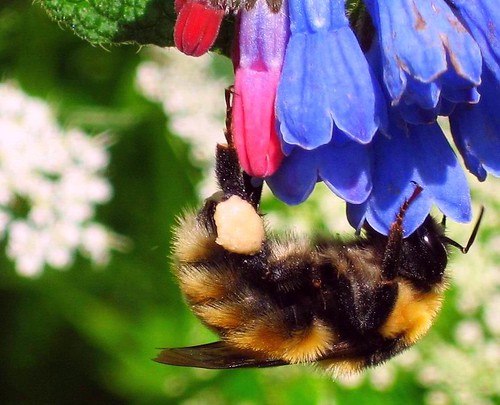
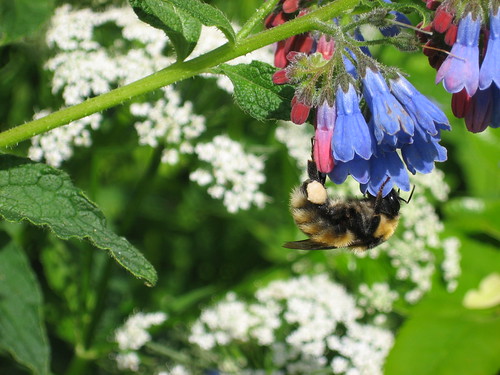
If you want to see the unprocessed image click here. I cropped it the wrong way, my bad. What was I thinking? The head of the bee almost didn't make it to the frame. There should have been more space in that direction. I also wasn't close enough to the subject. The DOF is okay though, and that pollen on its leg adds interest to the image. I only noticed that when the image was already in my laptop. I was quite amazed and the rest, as they say, is history.