skip to main |
skip to sidebar
“Life is all about timing... the unreachable becomes reachable, the unavailable become available, the unattainable... attainable. Have the patience, wait it out It's all about timing.”
Stacey Charter

Camera: Canon PowerShot A710 IS
Exposure: 0.002 sec (1/640)
Aperture: f/4
Focal Length: 5.8 mm
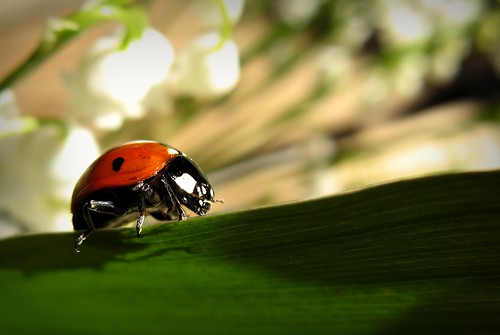
I mentioned in one of my previous entries that beginners should try to take photos of calm insects like beetles. Lady bugs are usually easy to take photos of, but it's important to capture it while doing something cool like attacking aphids or when it spread its wings. Needless to say, you have to watch its every move and be quick enough to capture them. If you don't have the patience, don't bother giving insect photography a try. Concentrate on still life photography instead.
I have some photos of lady bugs that look interesting simply because I was quick enough to press the shutter. Thanks to the adrenaline rush that I experience whenever I see cute insects. It makes me so alert, my heart beats faster than usual, I am just very focused on the bug and I wouldn't care about what is going on around me. Sounds like a case of love-at-first-sight? I think so too :-) What I find surprising is the fact that I never get shaky, which is great thing because until now I am still to experience how to use a tripod. Someday I will use one, that is when I already have Parkinson's disease.
Alright, so timing is important to make captures interesting, but how likely is it that something special is about to happen while closely monitoring the movements of the ladybug? If the ladybug is not comfortable with its surroundings of course it will fly away. It usually happens when it has no where else to go or based on my experience, when it's on human skin, it won't stay there for long so be prepared to press the shutter before its flight. When disturbed, the lady bug will release a yellow smelly substance from its joints so it's best to avoid touching it, unless you want a dirty bug as a subject.
Some say that they would love to take photos of ladybugs but they don't know where to find them. Lady bugs are usually on leaves of aphid-infested plants like roses. I also saw one ladybug crawling on a raspberry. These beetles are tiny, about 4-10 mm long but you will spot those spotted beauties because of their colors which stand out against greens. Knowing how the ladybugs look like during their early stages of life will also help you find them later on when they are already the photogenic insects that many people love. Here's a photo of ladybugs in their ugly phase:

I wanted to kick my self because I didn't get to witness the transformation of this lady bug:

It would have been great to have photos of it as it come out of its larva shell.
A few days later, guess what happened? I arrived at the scene too late again! Just like those cops in some movies. But at least you can see the larva shell better in this photo:

Next summer I will watch them like a hawk. But for now let me show that there were instances when I was on time:

1. Ooops, dead-end!
2. Climb every berry
3. seconds before take-off
4. For Cara
Those shots are not perfect, but they are unique. I think they are good enough, considering the fact that those were produced by a 7.1 mp compact camera. Again these are proofs a small camera doesn't always produce images of poor quality. It's the lack of passion for the craft that makes photos look dull.
“Never bend your head. Always hold it high. Look the world straight in the eye.”
~ Helen Keller

Straight in the eye
Camera: Canon PowerShot A710 IS
Date & Time: July 27, 2008 at 11.23am EEST
Location: Joensuu, Finland
Exposure: 0.017 sec (1/60)
Aperture: f/3.5
Focal Length: 5.8 mm
Modifications: cropping, adjusted brightness, contrast & color levels, noise reduction
Among the rules of animal and people photography is to focus on the eyes. It's a rule that I never questioned. I don't know about you, but I would definitely hate it if someone would take a photo of me and the camera is focused on the strands of gray hair on the crown of my head. Other than the fact that it would expose the ugly side of me, I am quite sure that no one would find it interesting.
According to Frank H. Philips: "On many bugs the eyes (and even bug “pupils”) lend a dramatic connection between them".. Hence photos focused on the bugs' eyes look very interesting. Since the day I read Frank Philips' tip, I have always aimed for the insects' or spiders' eyes. It is not easy, but eventually, you will get the hang of it. You just have to keep on practicing.
The major challenge in insect macrophotography is of course the size of the insects. To avoid immediate disappointment, look for bigger insects to practice on. Rhinoceros Beetles have big eyes and they are rather calm which means that you can take a hundred of photos of it if you want to. But those huge beetles are quite rare. Lady bugs and shield bugs are tiny but quite easy to photograph. Once you have spotted those critters, take as many photos as you can from different angles. Head-on perspective is my favorite. It is very challenging but I find it really cool, a hundred times more intersecting than a boring aerial view like this pic. Insects are beautiful and when photographed the right way, I think a lot of people would appreciate them more. I am quite pleased with the comments I got when I uploaded these pics:

1. in your face!
2. Fly
3. I dare you to move
4. face to face
To be fair with the bugs, I took a photo of my eye:

Vision of a sunset
Camera: Canon PowerShot A710 IS
Exposure: 0.017 sec (1/60)
Aperture: f/2.8
Focal Length: 5.8 mm
To view the large size click here
If you have the right equipment for macrophography then good for you. Your photos shouldn't suck, if they do, hmm shame on your gears :-) But if you are a P&S user like me, never ever focus on the limitations of your camera. The key is to get very close to the subject. Concentrate your efforts on following the basic principles of photography and you will never go wrong.
“Motivation is what gets you started. Habit is what keeps you going.”
~Jim Rohn

Location: Pähkinärinne, Vantaa ,Finland
Date taken: May 26, 2008 at 2.56pm EEST
Camera: Canon PowerShot A710IS
Exposure: 0.003 sec
Aperture: F/4
Focal length: 5.8 mm
Modifications: adjusted brightness & contrast levels, cropping,
noise reduction, added vignette
I picked this lady bug photo for this entry because I want to talk about my little accomplishments in the field of photography. If you think you couldn't bear reading this entry,
that's fine with me, just let me go on blabbing before I hit the sack. So here it goes...
In August of 2007, my shield bug photo was used for the article Ancient Giant Insects Breathing Easy. I was novice then, so the thought of my photo being good enough in the eyes of another person somehow felt nice. But who knows? Maybe the writer was just too desperate for images :-)
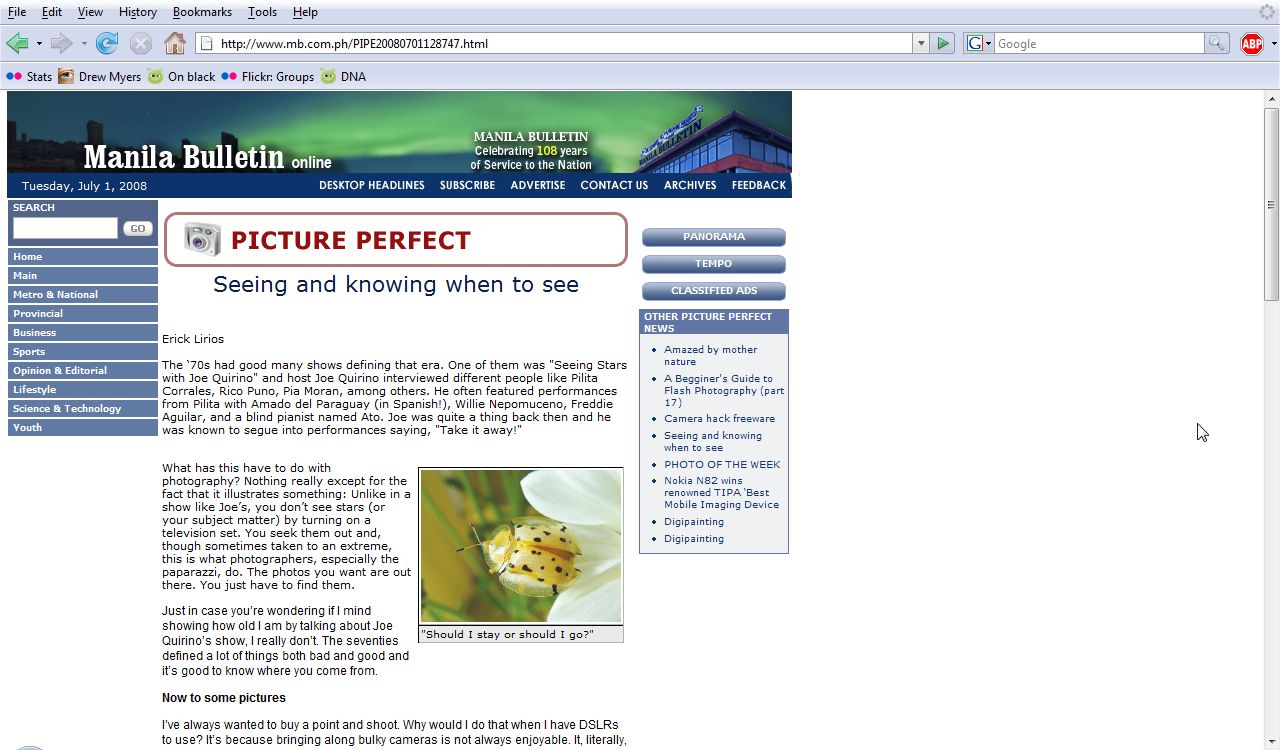
I was in the Philippines earlier this year. While I was there, my butt got featured in Manila Bulletin's Picture Perfect section.

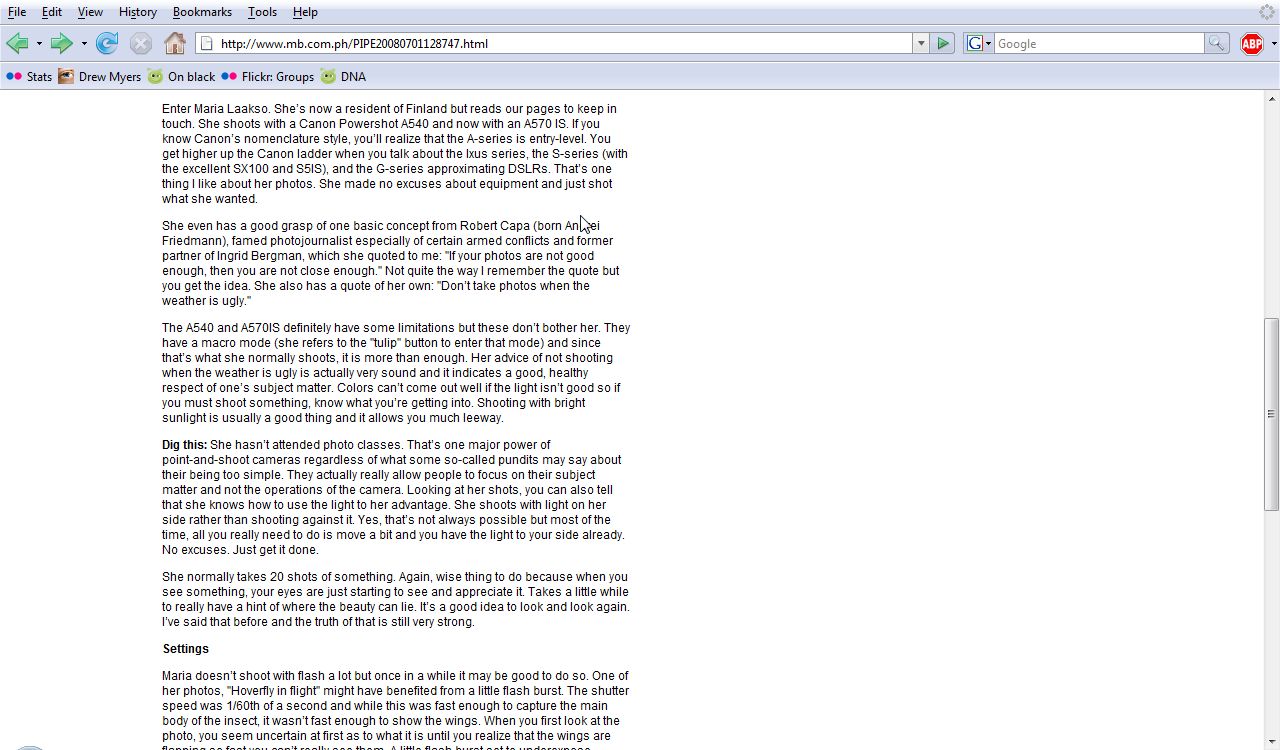
I didn't expect to see 6 of my photos in a national broadsheet. It was a big thing for me. It was also the first time for me to see the printed versions of my work. They didn't look bad. Picture Perfect is a good read for hobbyists. They sometimes feature tutorials & camera reviews. Unfortunately, I can't read anything from their column anymore, it always says "no other news". They should have that fixed. It worked in early summer though. Mr Eric Lirios wrote an excellent article about a certain point & shoot user :-) But because I was already here in Finland then, I didn't get to see the printed version right away. I had to ask someone to send me a copy of that paper. It was so wrinkled when it got here. I haven't taken a photo of it yet.
This morning I got a copy of JPG magazine from the mail. My spotted tortoise beetle photo is on page 94. It was among the photos that were chosen by the magazine's staff & JPG's members to be published for their Creatures feature. There could have been a short story about that pic, but regrettably, I noticed their e-mail too late. Darn! Maybe I was too busy with Flickr then.
So what's next? I don't know yet. I still learn new things everyday. Among my goals is to prove that in photography sometimes you won't need heavy gears for your work to be recognized. I guess I am doing okay.. so far.