skip to main |
skip to sidebar
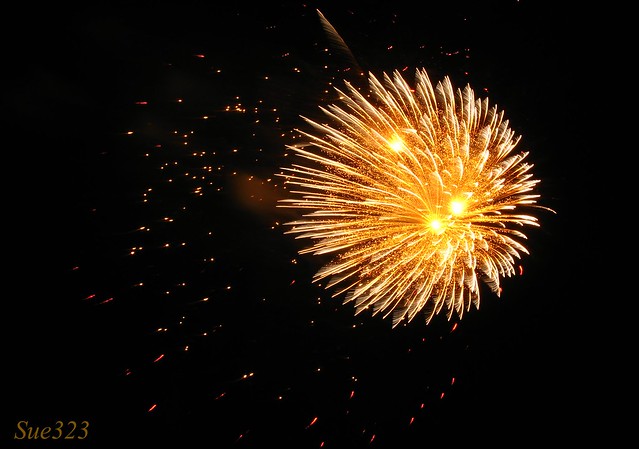 “We will open the book. Its pages are blank. We are going to put words on them ourselves. The book is called Opportunity and its first chapter is New Year's Day.”
~Edith Lovejoy PierceCamera: Canon PowerShot A710 IS
Date and time: January 1, 2012. 0:11 AM
Location: Isla Mujeres, Mexico
Exposure: 2
Aperture: f/8.0
Focal Length: 5.8 mm
Exposure Bias:0 EV
ISO Speed: 82
Handheld
I just came back from a 3-week vacation and my body clock is still messed up. Instead of wasting my time on reading some boring updates from social networking sites, I decided to bore others with my thoughts. So here I am updating my blog.
Before heading to the other continent, I planned to post my favorite shots from last year, but I didn't find the time to do that. The holiday activities kept my hands full. Anyhow, I mentioned last time I want to rekindle my love for photography, so kindly allow me to inspire myself as I look back at my personal faves from 2011...
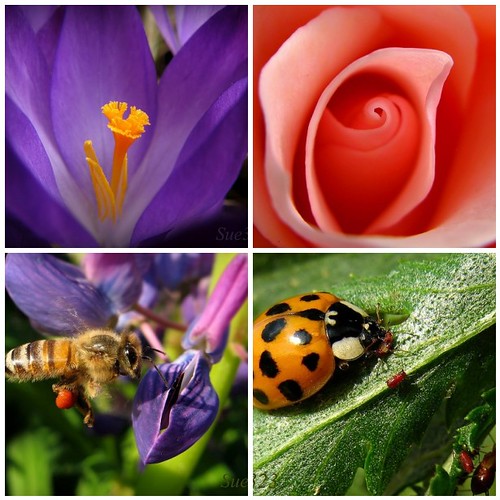
1. see me through, 2. mysterious you, 3. almost there, 4. red and sweet are good to eat
Although I didn't take much photos last year, I realized that I still managed to accomplish the usual stuff in my bucket list: insect in flight, a survival-of-the-fittest moment, insect porn, and dramatic-to-me flower macros. My camera failed to focus a few times, but there were occasions when it was its usual self. Not bad at all. Although I failed to improve my photography skill last year, the few photos show that I haven't lost my touch yet, me thinks.
Self-praising, check. Now it's time to move on. As a photography enthusiast, I do have secret goals. They are quite far-fetched, and because of that I will never dare mention them here. My fading enthusiasm and procrastination prevent me from trying to reach those crazy goals, but I will do my best to get those hindrances off my system. Once they're gone, I'm off to the next level. You just wait and see :-)
“Colors, like features, follow the changes of the emotions.”
~Pablo Picasso
Camera: Canon PowerShot A710 IS
Exposure: 0.001 sec (1/1250)
Aperture: f/4.0
Focal Length: 5.8 mm
Exposure Bias: 0 EV
Flash: Off, Did not fire
Modifications: cropping, adjusted brightness level
I'm soo missing summer right now. I can't post new photos to my gallery simply because there aren't new ones to upload. I don't have the time nor lovely subjects to take photos of. The last time I was out in the yard taking photos was more than a month ago. Could you believe that? My passion for photography is still pretty much alive, it's just that the weather hasn't been on my side since last month. We've got snow already. Yup, winter- my worst enemy- is here again. No more lovely days in the horizon, take a look at our city's weather forecast:

source: Foreca
I am not a fan of neutral colors, I guess I never would be. I love colors that brighten my mood. Now that almost everything is grey and white, I terribly need an antidote for depression. My saving grace is my Flickr photo page where there are hundreds of colorful pics. The ones with pink subjects caught my eye the most. I love taking photos of pink subjects because they remind me of strawberry ice cream. Pink never fails to make me smile. In addition, it's an easy color to shoot.
Last summer, I noticed that insects are attracted to the color pink. Maybe I owe my macro shots to the pink items in my wardrobe. Here's one example, you non-believers!
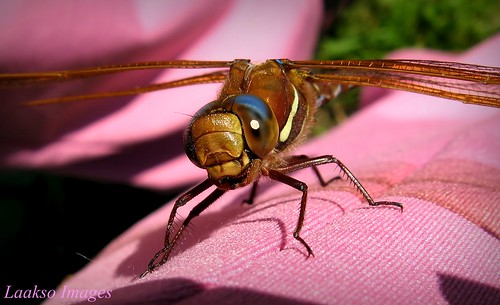
I saw that huge dragonfly zooming around the garden. I wanted to stalk it for photos, but to my surprise it went to me instead. It landed on my leg for like 3 minutes and I took a couple of photos. Thank goodness for the color pink. My theory about insects' pink fetish started last summer when our guests who had pink shirts on were often bugged by wasps and other bugs. I also noticed that I have tens of bug-on-pink-flower photos in my Flickr page.

Pink subjects look their best on a nice weather. Whenever I see the need to adjust color levels, I add more blue to get a nice shade of pink. Try doing the same to your photos with pink subjects. Oh and wear something pink when you're taking nature photos. Maybe it will land you a pleasant surprise too.
Limitations live only in our minds. But if we use our imaginations, our possibilities become limitless.
~Jamie Paolinetti
Face the truth
Camera: Canon PowerShot A710 IS
Exposure: 0.003 sec (1/400)
Aperture: f/4.0
Focal Length: 5.8 mm
Modifications: Cropping, contrast and color levels
Date taken: August 2, 2009 at 4.06pm EEST
My summer vacation is almost over. Before school work and other projects get in the way, I reckon that I should first show everyone my favourite summer photos. Just some pieces of evidence to prove that little cameras can really produce nice images.
The number of photos I've taken from June 'til the first week of August is about 30% lesser than the previous summers'. That doesn't mean that I've lost my interest in photography. I used to take at least 8 shots of the same subject. Nowadays, 2 to 4 shots are usually enough. My goal is to get sharp head-on shots as much as possible. I incline to believe that my abilities can go beyond images like this one:
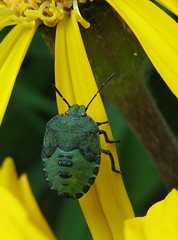
Though the backs of beetles and bugs have cool patterns, I still think that eyes and faces are their best features. Hence, I did my very best this season to capture the cute faces of insects, and guess what? My camera didn't fail me. Behold my best insect photos to date:
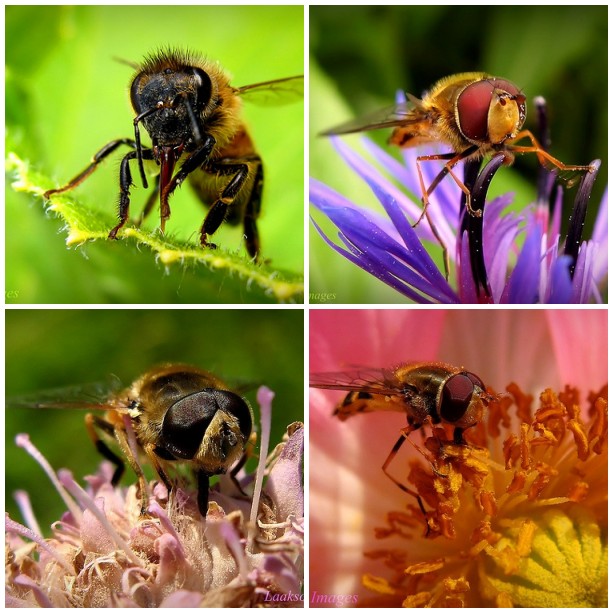
1. bee ready
2. Snack time
3. scavenging
4. Happy Pretty Pink Poppy Tuesday!
I always get comments like: How did you do that when you're only using a point-and-shoot camera? Perhaps it's because no matter how inferior my camera may seem to some people, when I go out to take photos, I really mean business. Yeah, my camera have limited features, but I just couldn't be bothered to pay attention on what it cannot do. If I'm not happy with the shots, I don't blame it on the so-called limits of my point-and-shoot. I don't whine, I just tell myself that I'd get it right next time.
Hobbyists often say: 'it's the arrow, not the Indian', whenever talks about cameras and gear come about. I think the same thing applies to photos of poor quality, it's quite pointless to pin the blame on the arrow :-).
You've got to be original, because if you're like someone else, what do they need you for?
~Bernadette Peters
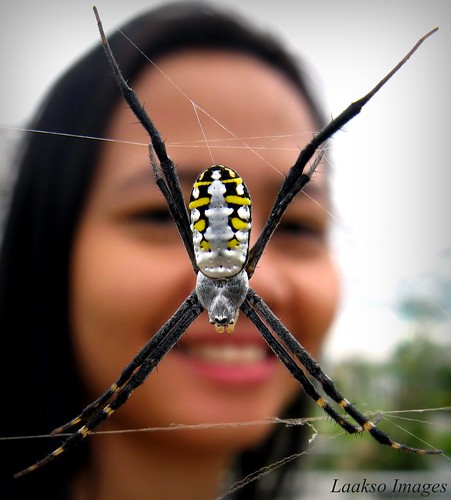
Date & time: January 19, 2008 at 13.07 GMT+8
Location: Bulacan, Philippines
Camera: Canon PowerShot A710 IS
Exposure: 0.003 sec (1/320)
Aperture: f/4.0
Focal Length: 5.8 mm
I've got a confession to make. Almost 2 years ago I envied this shot so much and I even tried to imitate it. One summer morning, I found a similar bug in my mom-in-law's garden, I put it on top of a red flower and started to take photos. Then I realized that it was silly, why on earth would I copy one's work? I felt awful, so I brought the bug back to where it was and just took pictures of it in many different angles. Here's a pic of little greenie.
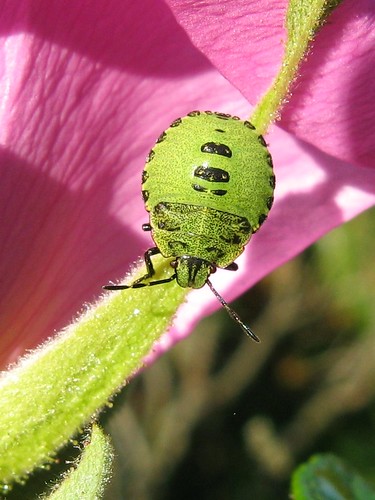
The morning light definitely did wonders to the photo. Composition-wise, I am not very proud of that shot but at least the colors and details look nice. More importantly, I learned that
imitating others' work for the purpose of gaining the approval of many is super insane. Some may think that my photos are nice but of course I can not please everyone. Since then, I just concentrated on learning how to take better photos and bear in mind that photography should always be fun.
I've got many Flickr contacts who are exceptionally skilled, each visit to their gallery brings delight to my senses because their shots never cease to inspire and amaze me. Time and again, I come across cool concepts for photos but I couldn't be bothered to imitate how the shot was executed, etc. I sometimes participate in Imagoism Thursday, but I just don't have the knack of composing shot the way V does. One thing that I learned from that weekly photo contest is that once in a while, I can apply the 'drama' my insect shots.

Bid me farewell
I haven't been actively participating in Imagoism Thursday because I just don't have many photos that would look good enough alongside the work of other Filipino photographers. Moreover, I just can be half as good as V when it comes to composing shots. I think I'm better off admiring her work from the sidelines.
Like in any form of art, originality is valued in photography. What's the point of imitating a shot that has been done thousands of times before? It's a waste of time. Coming up with unique compositions is the way to go. As usual I would like to emphasize that clever concepts do not require high-end gears, it's a matter of making brain cells work.
Uniqueness is what I've always been aiming at to the point that somehow it makes my shots extra weird. Nonetheless, I believe they deserve extra points in the originality department. Who else would be brave to get extremely close to spider webs or crazy enough to self-portraits from butt-level? Call it kick-ass originality, baby ;-)
And it's not the thing you do, dear,
It's the thing you leave undone,
Which gives you a bit of heartache
At the setting of the sun.
~Margaret E. Sangster
The Sin of Omission
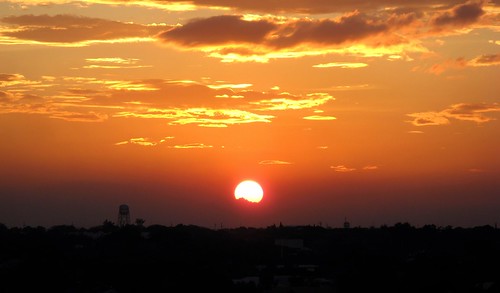
Camera: Canon PowerShot A710 IS
Exposure: 0.003 sec (1/320)
Aperture: f/4.8
Focal Length: 34.8 mm
Date & Time: March 17, 2008 7.03pm (GMT+8)
Location: Alabang, Philippines
Modifications: Noise reduction, cropping
My interest in photography started more than 10 years ago. I always had my little film camera with me wherever I go but I only took photos of sunsets. Back then, I thought that I would never ever get to take good photos because photography could be a very expensive hobby and I had more important things to spend my money on. But look at me now.. I still don't spend anything in the name of photography hahaha! I haven't changed at all. I still take photos of sunsets once in a while though. I think sunset captures will never fail to fascinate most people. Moreover, it is very easy, I bet you can even do it with your eyes closed.
Anyone can take photos of sunsets. Hence, they may sometimes look too ordinary especially for more experienced photographers. However, there are several ways to jazz up sunset shots. I am not talking about over-processing the image. It's more of adding drama to the image through forced perspective. Last year, I saw a wedding photo of a bride 'kissing' the sun. I thought it was a clever idea. I've seen some sunset photos that are rather forgettable but the unique ones have always served as a reminder that sunset shots can be less boring. My friend Romy nicely applied forced perspective on this sunset pic, now compare it with my absolutely predictable shots, and you would understand what I am talking about.
I rarely take photos of sunsets here because tall trees obscure my view. But an idea struck me last Friday as I was arranging our plants in our kitchen. Since plants are within reach and the sunset is in sight, I thought I should combine them in an image. Here's my feeble attempt at spicing up a sunset moment:
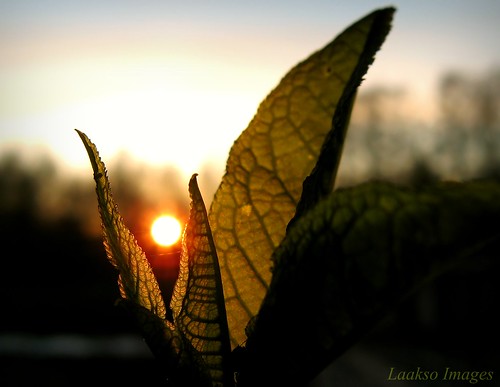
I was a bit reluctant to upload that shot to my photo stream, I thought that some may find it weird and ugly. Surprisingly, the super nice members of the Flickr community didn't find it as a lame attempt. Now I am aware that my sunset view isn't that bad and I can occasionally capture sunset moments indoors when I've got nothing else to take photos of. Good thing that I didn't let my doubts take control of me. As a result, I've got no heartaches secondary to things left undone.
“Light thinks it travels faster than anything but it is wrong. No matter how fast light travels, it finds the darkness has always got there first, and is waiting for it.”
~Terry Pratchet
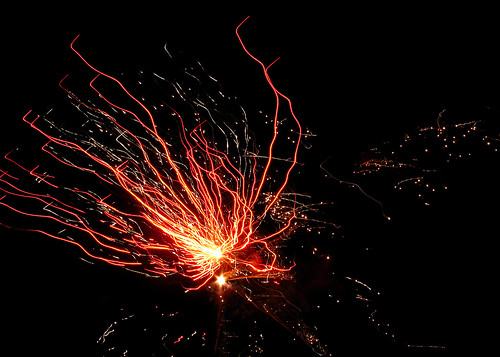
Camera: Canon PowerShot A710 IS
Exposure: 2 sec (2)
Aperture: f/8
Focal Length: 13.2 mm
Modifications: adjusted contrast level, cropping
Date & time: December 27, 2008 10;05PM
Location: Santa Rosa Laguna, Philippines
I have mentioned that I prefer taking photos on a nice weather because I want to make use of natural light. In close up photos, flash can highlight minute details, that is, if it's not too bright. Using flash while shooting subjects that have light colors like pale yellow or those that have shades of white may give you disastrous images as results. The photo below was taken in a butterfly sanctuary in Finland:
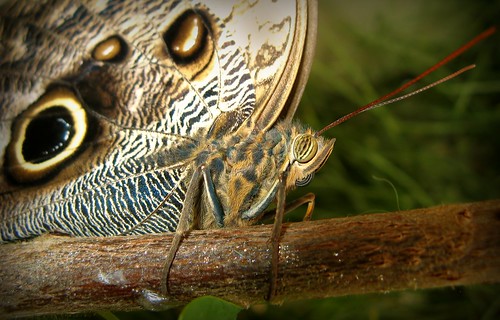
The subject was in the shade, had I disabled the flash, we wouldn't get to appreciate the interesting pattern in its eyes. Most of the photos in my photostream are close up shots of bugs and flowers, however, 90 percent of the photos were taken in natural light. Why? Because there are instances when flash ruined my shots, and I don't want to make the same mistakes. I rarely go out on a gloomy weather when it's too dark for me to take pictures. Yes, I am afraid of the dark. I also didn't want to waste time on shooting scenes that my camera may not handle. But I discovered recently that taking long exposure shots with my camera is not as difficult as I thought. I even managed to take fireworks photos without a tripod, and surprisingly, some turned out very good

Good results always motivate me. Right now, I am considering going beyond nature close-ups and perfect lighting conditions, but that does not mean that I will get a new camera. I am a super newbie in the night shots department, my lack of knowledge in long exposure shots plus my ignorance of the features of my camera kept me in the dark for years. A new equipment can not guarantee that I would master long exposure shots immediately, it may ages for me to get used to different camera functions or settings. For now I think that I should concentrate on learning new techniques. The fireworks of new year's eve made me realize that I should not fear darkness as far as photography is concerned. My photography should not be a 9 to 5 thing because I can take photos even after sunset and they may turn out nice. I have always wanted to see the aurora borealis. I hope that when I finally get to witness that awesome phenomenon, I am already good enough to perfectly capture it with my compact camera.
“Life is all about timing... the unreachable becomes reachable, the unavailable become available, the unattainable... attainable. Have the patience, wait it out It's all about timing.”
Stacey Charter
Camera: Canon PowerShot A710 IS
Exposure: 0.002 sec (1/640)
Aperture: f/4
Focal Length: 5.8 mm
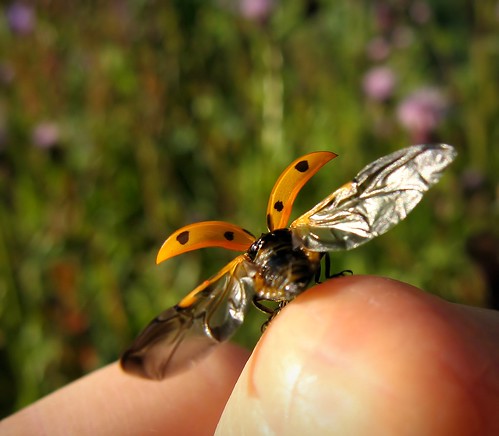
I mentioned in one of my previous entries that beginners should try to take photos of calm insects like beetles. Lady bugs are usually easy to take photos of, but it's important to capture it while doing something cool like attacking aphids or when it spread its wings. Needless to say, you have to watch its every move and be quick enough to capture them. If you don't have the patience, don't bother giving insect photography a try. Concentrate on still life photography instead.
I have some photos of lady bugs that look interesting simply because I was quick enough to press the shutter. Thanks to the adrenaline rush that I experience whenever I see cute insects. It makes me so alert, my heart beats faster than usual, I am just very focused on the bug and I wouldn't care about what is going on around me. Sounds like a case of love-at-first-sight? I think so too :-) What I find surprising is the fact that I never get shaky, which is great thing because until now I am still to experience how to use a tripod. Someday I will use one, that is when I already have Parkinson's disease.
Alright, so timing is important to make captures interesting, but how likely is it that something special is about to happen while closely monitoring the movements of the ladybug? If the ladybug is not comfortable with its surroundings of course it will fly away. It usually happens when it has no where else to go or based on my experience, when it's on human skin, it won't stay there for long so be prepared to press the shutter before its flight. When disturbed, the lady bug will release a yellow smelly substance from its joints so it's best to avoid touching it, unless you want a dirty bug as a subject.
Some say that they would love to take photos of ladybugs but they don't know where to find them. Lady bugs are usually on leaves of aphid-infested plants like roses. I also saw one ladybug crawling on a raspberry. These beetles are tiny, about 4-10 mm long but you will spot those spotted beauties because of their colors which stand out against greens. Knowing how the ladybugs look like during their early stages of life will also help you find them later on when they are already the photogenic insects that many people love. Here's a photo of ladybugs in their ugly phase:

I wanted to kick my self because I didn't get to witness the transformation of this lady bug:
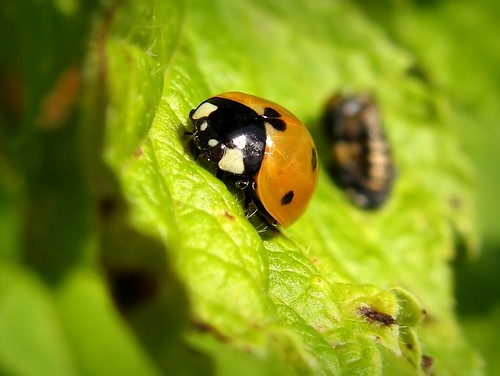
It would have been great to have photos of it as it come out of its larva shell.
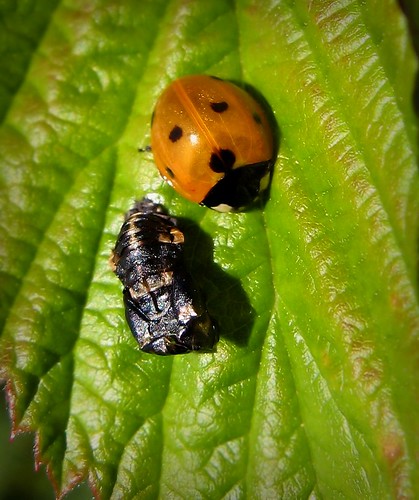
A few days later, guess what happened? I arrived at the scene too late again! Just like those cops in some movies. But at least you can see the larva shell better in this photo:
Next summer I will watch them like a hawk. But for now let me show that there were instances when I was on time:
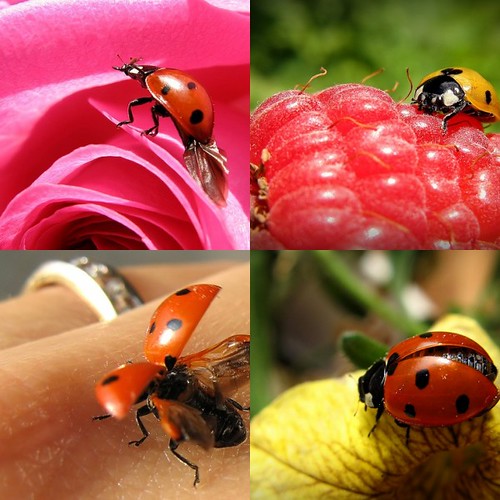
1. Ooops, dead-end!
2. Climb every berry
3. seconds before take-off
4. For Cara
Those shots are not perfect, but they are unique. I think they are good enough, considering the fact that those were produced by a 7.1 mp compact camera. Again these are proofs a small camera doesn't always produce images of poor quality. It's the lack of passion for the craft that makes photos look dull.
“The policy of being too cautious is the greatest risk of all.”
~ Jawaharlal Nehru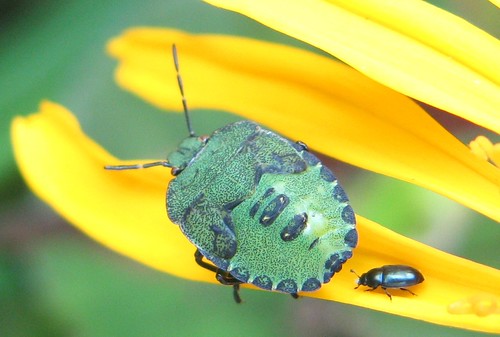 Stalked!Camera: Canon Powershot A710IS
Location:Punkaharju, Finland
Date & time: 5.36pm EEST
Exposure: 0.017 sec
Aperture: f/2.8
Focal length: 5.8mm
Modifications: cropping, adjusted brightness & contrast levels
I am keen on learning more about insect photography. I always read tips from some forums and blogs of professional photographers. Sometimes reading about some so-called tips make me wince. I was shocked to find out that some photographers resort to freezing bugs so that they could get 'better' photos of them. I think that is very wrong to sacrifice a bug's precious life for the sake of art. Talk about some human's selfish needs. No wonder so many species are now extinct. In my opinion such form short cutting defeats the real purpose of nature photography. There's nothing like capturing nature's priceless moments.
In case you find nature macrophotography very interesting, then by all means give it a shot. It's not exclusive to people with high-end cameras, if it was then I would not have the thousands of bugs and flower close-ups that are in my hard disk right now. I already have an entry about flower macros. For now I want to share with you how to find and stalk bugs in their natural environment.
One thing that you should do as you walk close to the subject is to adjust your camera settings. Lower the exposure if the light is too harsh. Do you think you need to change the white balance? Do all the necessary adjustments prior to getting up close to the bug.
Spiders
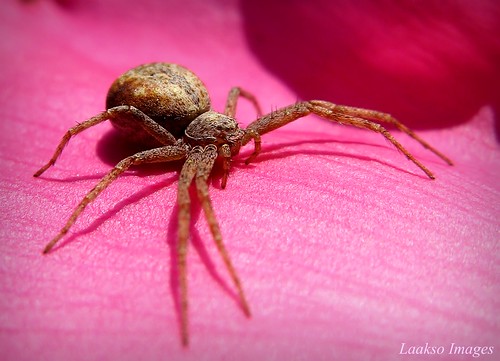
It's quite easy to find spiders. If not in their web, they are usually on leaves or crawling on the ground. These 8-legged creatures are not insects. They don't have wings, but once they sense your presence they will disappear in flash. Why? Because most of them have 8 eyes that's why they can easily detect human presence. Getting good photos of them is a bit difficult, but not impossible. Just don't do anything that will startle them, move very slow but press that shutter like a maniac. If you are very close, make sure that your camera won't accidentally hit the leaf or whatever the spider is on because it's going to blow your chance to take more photos. In a blink of an eye spidey will be somewhere else. Here are two spiders who didn't mind me taking photos of them:
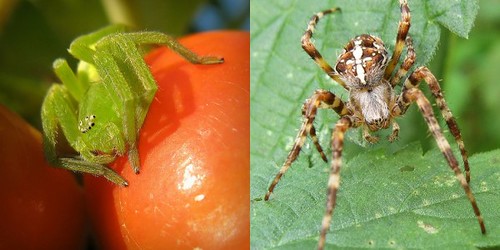
1. Greenie
2. Spider on a stinging nettle
Bumble bees
These ever buzzing winged insects are very restless especially if they are surrounded by plenty of tiny flowers. A bumble bee will just stay on a flower for a few seconds. They are normally too busy to get intimidated by the camera, but you have to press on the shutter as fast as you can. I haven't had the luxury of time to use manual focus on bumble bees. My camera is always on full auto mode whenever I take photos of them. My best shots bumble bees:
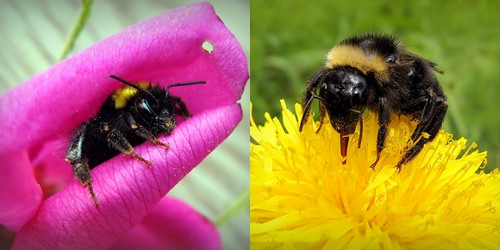
1. Coming out of the shell
2. Another day in the office
Honey bees
If bumble bees are always in a hurry to get things done, honey bees are different. They are quite methodical. Hence, easier to photograph. You can follow it's movement from one flower to another and you can take many shots of it because it stays on a spot for a minute or more.
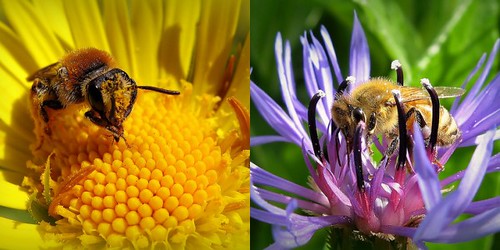
1. And yet another hard worker
2. Behind bars
Hover flies
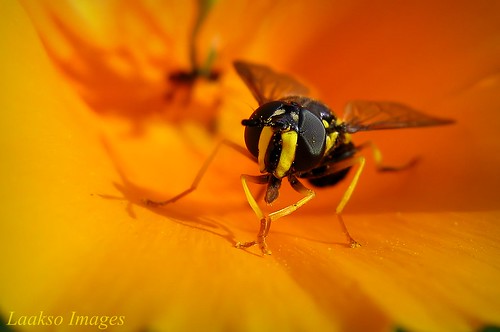
I have plenty of hover fly photos in my gallery. Based on my experience, they are the easiest winged creatures to take photos of. You can find them on flowers and sometimes they rest on leaves or blades of grass. You can be just inches away from them but they would not care, except if you will shake the leaf or flower. Once you are used to taking photos of bumble bees & honey bees, then you can effortlessly photograph hover flies. You an experiment on many different angles. Hover flies are twice smaller than bumble bees, to capture more of its detail you have to be really close to them.
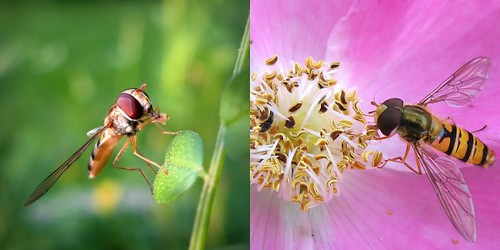
1. A praying hoverfly?
2. in the middle of something
Butterflies
These lovely creatures are probably everyone's favorite insect. Photographing them is quite challenging. Once you see one on a flower, approach it slowly. Your mere shadow will ruin your chance to take photos of these winged insects. So try your best not to cast your shadow over it. If you startled accidentally, it will fly away. But don't fret, because it will come back to the same spot where you saw it. I've seen it happen several times. Like when I took these photos:
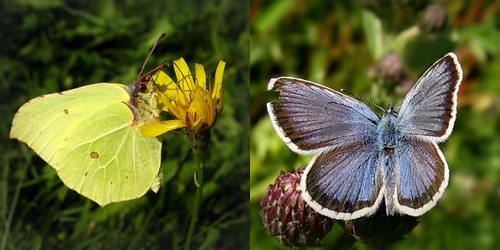
1. A summer remembrance
2. Monday blues
The first time I saw a huge moth was when I was 5 years old. It was orange with beautiful patterns on its wings. The wing span of that moth as about 18-20 centimeters. It was my mom who saw it first. Until now I remember how that moth looked like. Sadly, it was the first and last time that I saw such a beautiful live moth. I saw something that looked almost like it but it was in a butterfly museum in Asia, pinned on a wall. I probably would never see anything like that in this lifetime. So while some species are still alive, let's not waste the opportunity. Photograph them while you can. A few decades from today they may no longer be around, but if you took the risk of getting up close to those critters then you will have beautiful pictures to show to your grandchildren someday.
“All nature's creatures join to express nature's purpose. Somewhere in their mounting and mating, rutting and butting is the very secret of nature itself.”~ Graham Swift
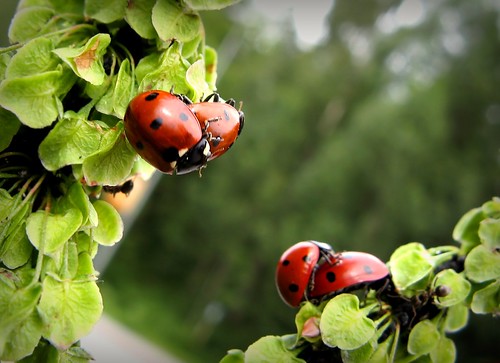 Make love, not war
Location: Pähkinärinne, Vantaa. Southern Finland
Date & Time: June 28, 2008 4.09PM EET
Camera: Canon PowerShot A710IS
Exposure: 0.008 sec
Aperture: f/4
Focal length: 5.8mm
Among the advantages of a compact camera is that its size and weight won't interfere that much with your daily routine. Take the photo above as an example. I took that on the way home from the grocery and I had two shopping bags at the time. I can't imagine taking photos of bugs by the road side with a heavy DSLR while carrying bags of groceries I am not strong enough to do that.
It's so easy to take photos of insects while they are mating. You can take 100 photos of them is you are quick enough. But that will leave you with so much work afterwards. If you want to upload the photos later to your online gallery, it's a must to pick the best ones, otherwise the photo viewers may get bored to death except of course if they are entomologists who would like to carefully document the bugs' mating process. Once you see a mating pair, don't be afraid to get very close to them. Trust me, they would rarely mind your presence unless startle them by moving the leaves or petals where they are. But when do they mate? The earliest time of the day when I saw mating butterflies was at 11 AM. I once took photos of beetles mating at 7 PM, the evening light was nice then. Of course if there is a butterfly park near you, there would always be mating couples there. But if you are like me who don't have much choice but to look for them in the wild, you have to be alert. Once you see two of the same kind of butterfly, there's a big chance that they are in the middle of a courting ritual. Try not to disturb them and just walk closer to their direction when they get down to the actual business. Beetles are easier to capture because they don't move much. In addition to that, they mate for hours. You will have a lot of time to take photos them. When I was on vacation in the Philippines, I saw mating tortoise beetles while I was on my way to a nearby mall. I took photos of that couple and then after my 2-hour mall trip, they were still at it. Get the picture?
Presenting.. my porn collection:
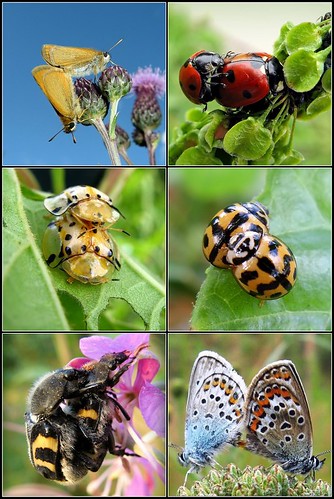
1. Caught in the act, 2. Size doesn't matter?, 3. Afternoon delight, 4. bugs in love, 5. mating beetles, 6. mating butterflies
If you find those photos funny & interesting, why not give insect porn a try? Forget about giving those bugs some privacy, they do it by the road side for crying out loud. Just look for them and keep in mind that sex sells.
“Luck is what happens when preparation meets opportunity” ~Seneca
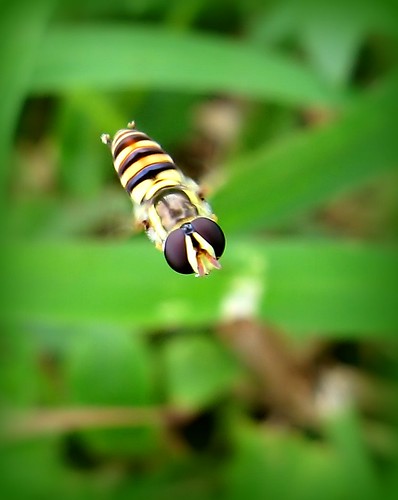
Hover fly in flight
Location: Filinvest Alabang, Muntinlupa Philippines
Date: January 1, 2008, 3:23 PM Manila time
Camera: Canon PowerShot A710 IS
Exposure: 0.017 sec
Aperture: 3.5
Modifications: Cropping, adjusted brightness, noise reduction
If you have visited my Flickr photostream, you may have noticed that usually my reply to comments is: "it's just a lucky shot" especially when it is about photos of insects in flight. I even referred to the photo above as 'my ultimate lucky shot', why? Because it really was. I took that photo while I was in the Philippines. It was the first day of the year and I was my nephew's baby sitter for the day. We were walking along Filinvest Avenue in Muntinlupa. Of course I was prepared to take photos. I hoped to find lady bugs, but I didn't find any. Then I noticed a bug in stationary flight! Oh joy, oh rapture! If I may borrow that line from Helga G. Pataki. I normally take more than 10 shots of my subjects but that time, I didn't have the chance to press the shutter more twice. Thanks to little Clarence John for scaring the bug with his hand. When I asked him why he scared it away, his response was: "it may bite me". A piece of advise: if you want to capture insects in flight, don't bring a kid along, it's for your own good. Fortunately one of the photos turned out okay and it's my most interesting photo to date.
Okay so I did it once, big deal, but can I manage a shot like that again? The geek in me analyzed the probability. Based on my experience, taking photos of bugs in the Philippines wasn't exactly a walk in the park. I think the warm climate is the culprit, it makes bugs hyperactive. The temperature during summer months here in Finland will never match the summers in the tropics. That means that insects here can't be as restless. In a addition to that, my nephew doesn't live here, so I though maybe I can capture bugs in flight again. It shouldn't be impossible. And besides taking photos of insects on flowers or leaves has become too easy for me. I wanted to challenge myself that's why not so long ago, I set a goal to capture bugs in flight, while they are around. I found out that it is not time-consuming because you will only have a few seconds to press the shutter. I considered that as a good thing because at least I was able to attend to other things in the backyard like weeding & watering the plants.
Here are some of my bugs in flight photos:
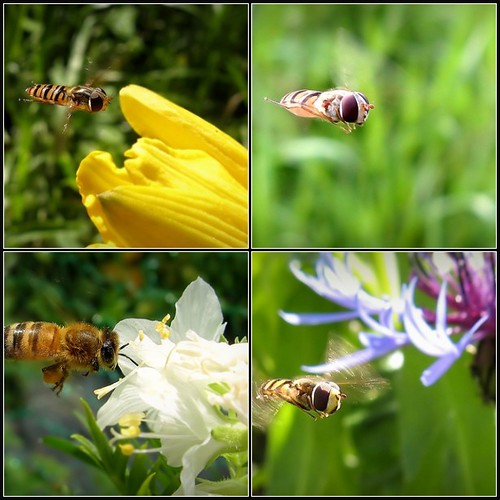
1. Ready or not, here I come!, 2. captured in flight, 3. Almost there, 4. Off to the next destination
"How did you do that?", some viewers asked. Well, I was prepared to capture those critters and grabbed the opportunity to fire a few shots at them while they were in midair. Based on Seneca's quote, I can consider it as luck. So if you want to take photos of flying insects, remember that you need patience, camera and luck :-)